


Market Economics


European house prices continue to outpace wages
(November 2026) – House prices are rising faster than average wages, putting home ownership increasingly out of reach. Measured against local incomes, Europe’s least affordable city is Vlorë, Albania, where purchasing a newly built 70-square-metre apartment requires the equivalent of 21.3 average gross annual salaries. At the opposite end of the ranking, Turin remains the most affordable city, where purchasing a new apartment requires the equivalent of 4.7 average gross annual salaries.
 Deloitte’s 2026 Property Index. Overview of European Residential Markets based on 2025 data, provides a detailed city-by-city assessment of housing affordability across Europe. The analysis covers locations for which both average new-build housing prices and gross annual salary data are available. Affordability is expressed as the average number of gross annual salaries required to purchase a newly built 70-square-metre apartment. By relating house prices to local earnings, the indicator provides a more realistic measure of home ownership affordability than property prices alone and allows for meaningful comparisons between cities and countries.
As mentioned, the least affordable city in the 2026 ranking is Vlorë, Albania, where purchasing a newly built 70-square-metre apartment requires the equivalent of 21.3 average gross annual salaries. The decline in affordability reflects strong demand for coastal property, growing interest from domestic and international investors, the expansion of premium waterfront developments and rising expectations surrounding tourism growth and major infrastructure projects. Prague ranks second, with a new home costing the equivalent of 16.9 annual salaries. This represents a marked deterioration from the 15 annual salaries recorded for 2024. Athens is third at 16 annual salaries, up from 15.3 the previous year. In both cities, house prices have risen faster than average wages, further eroding affordability for local households.
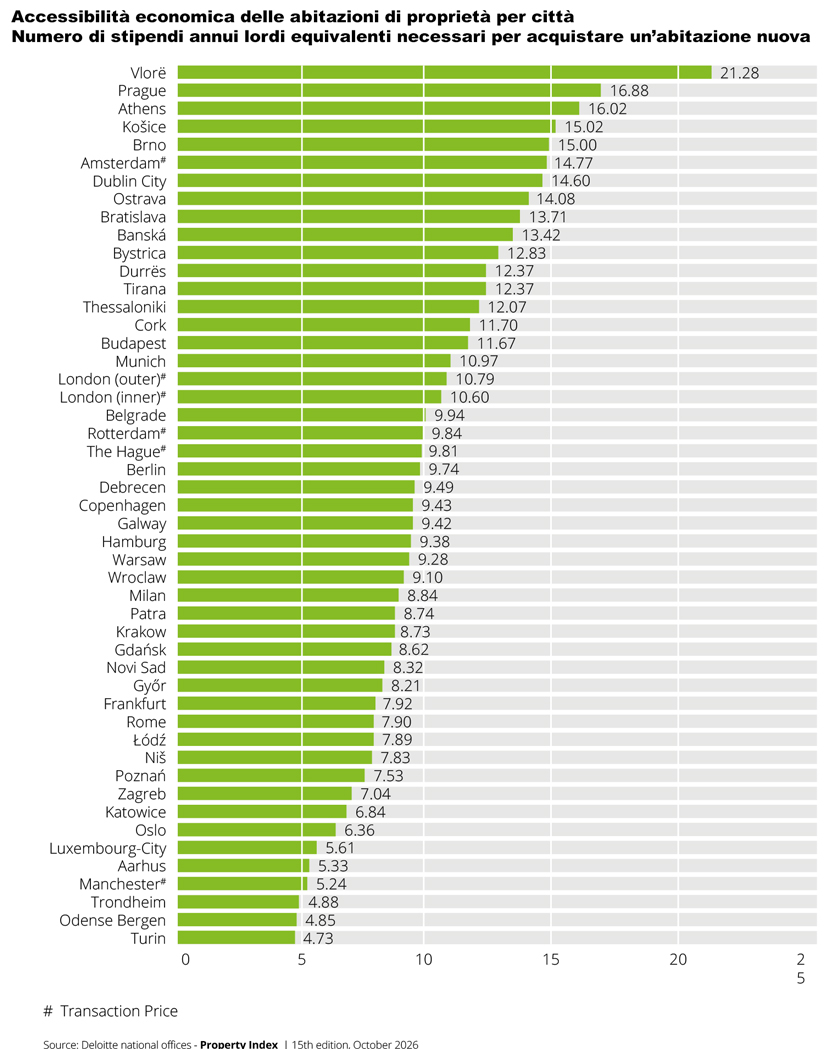
Other relatively unaffordable cities include Košice in Slovakia and Brno in the Czech Republic, both at 15 annual salaries. Along with Amsterdam (14.8), Dublin (14.6), Ostrava (14.1), Bratislava (13.7) and Banská Bystrica in Slovakia (13.4), these figures show that affordability pressures are no longer confined to traditionally expensive capitals but are increasingly affecting regional cities as well.
The 2025 figures reveal a broader deterioration in housing affordability across Europe. Whereas the 2024 edition identified just 11 cities where purchasing a new home required more than ten average annual salaries, the number rose to 19 in 2025. This suggests that residential property prices continue to outpace wage growth in many urban markets, placing home ownership increasingly beyond the reach of local residents. Other highly affordable cities include Bergen (4.9), Odense (4.9), Trondheim (5.2), Manchester (5.3) and Aarhus (5.6).
Affordability trends are not, however, uniform across Europe. While several of the least affordable cities have become more expensive in relation to local incomes, many of the more affordable locations have remained broadly stable or even improved slightly. In Turin, for example, the figure fell from 4.9 to 4.7 annual salaries, while affordability in Odense and Aarhus changed only marginally. This suggests that affordability pressures remain concentrated primarily in already expensive property markets, where residential prices continue to rise faster than household incomes. City-level comparisons also reveal significant differences within individual countries. In Greece, for example, buying a new home in Athens requires almost twice as many annual salaries as in Patras (16 compared with 8.8).
These disparities underscore the importance of analysing property markets at city level, as national averages can conceal substantial regional differences. Although house prices and wage levels remain the main determinants of affordability, several other factors influence access to home ownership. These include mortgage rates, bank lending conditions, constraints on housing supply, demographic trends, urbanisation and the growing importance of investment demand in certain markets. Together, these factors continue to shape housing affordability across Europe.
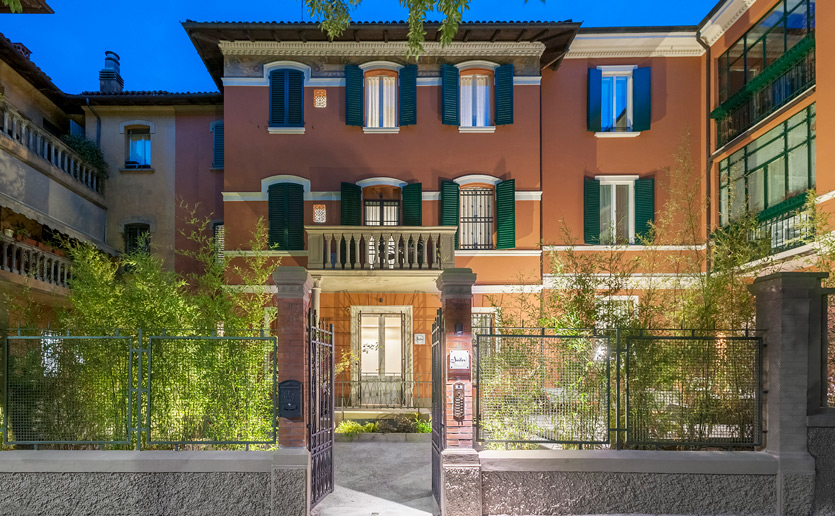
(© RCX Photography)
