Culture


“I’m not a product designer, I develop projects”
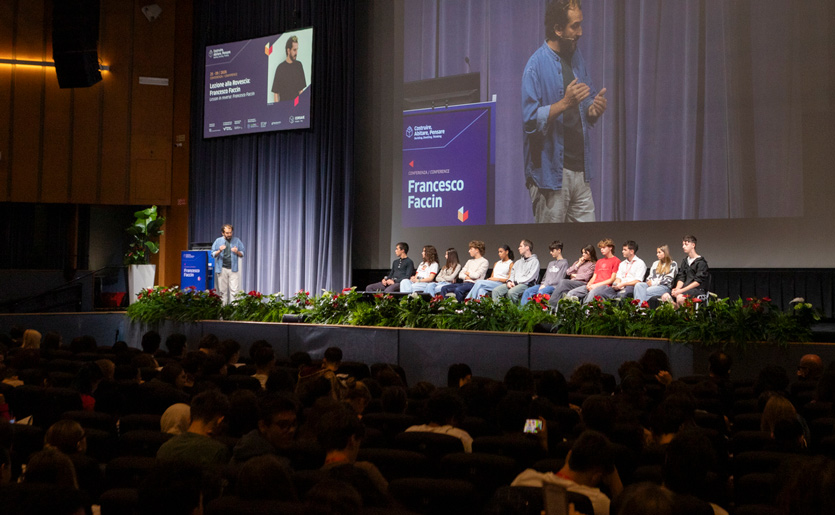
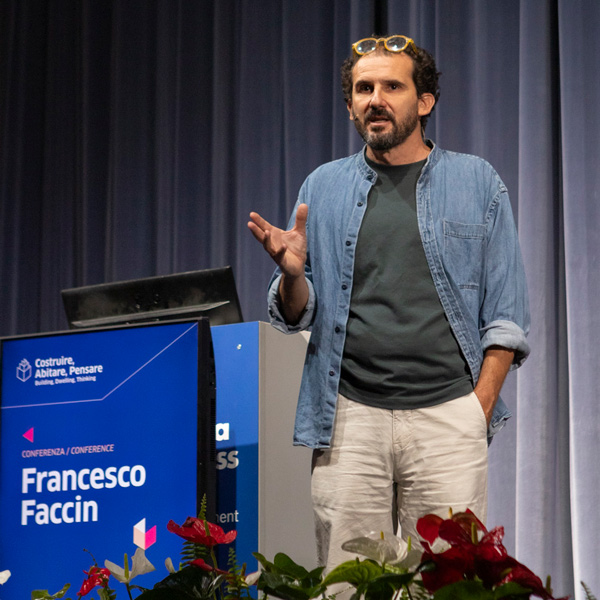 (November 2026) – Francesco Faccin, guest speaker at Cersaie’s 2026 Lesson in Reverse, is a free-thinking designer, perhaps one reason why he was able to hold the undivided attention of more than 1,300 secondary school students who had travelled to Bologna to hear him.
The format itself was also rather unconventional. More than any previous guest speaker, Faccin took the idea of a Lesson in Reverse literally: instead of giving a talk, he said very little unprompted and spent an hour and a half answering students’ questions. He showed only a handful of images of his work, instead relying on words and ideas to explain to the young audience his philosophy of design and, more broadly, his view of the world. For all the talk about younger generations being unable to listen to someone speaking for any length of time, the concentration in the room was almost palpable, perhaps because Faccin simply let the students set the agenda with their questions and curiosity.
More than a product designer
Faccin draws a distinction between the conventional Italian use of the word ‘designer’, which is strongly associated with product design, and the broader role of the ‘progettista’. “In Italy,” he said, “the English word ‘design’ has largely become synonymous with product design. But I prefer the word ‘progetto’ [project], partly because it comes from Latin, and I like to use words that are part of our linguistic heritage and have evolved over time. Its Latin roots, ‘pro iacere’, literally mean ‘to throw forward’. The word itself suggests that designing means doing something in the present that will shape the future, so the idea of responsibility is already built into it. What kind of things are we going to project into the future? Ugly things? Meaningless things? I imagine that, if asked, you would all agree that it makes sense to project worthwhile things into the future, things that address the urgent challenges of the present.”
A small studio
Unlike many other designers, Faccin deliberately keeps his studio small, with only a small team. “I want to stay small because it allows me to be more selective about the clients I work with,” he explained. This means choosing clients who broadly share his outlook, helping to avoid conflicts later in the design process. It also means rejecting the practice of attaching the label ‘design’ to a product simply to increase the client’s profits – and, he added, the designer’s too.
Creativity doesn’t exist
Faccin was equally provocative on the subject of creativity. “Creativity doesn’t exist,” he said. “I simply immerse myself in each project and follow a series of steps that make it seem as though the project emerges by itself,” he said. “I don’t believe in creativity , in some kind of creative spark that suddenly gives someone an idea while they are sitting under a tree. After 25 years, I can say with certainty that all projects arise from a fairly logical process. I follow a method: I talk to the client, study the context the project has to respond to and carry out a typological analysis. If I’m asked to design a lamp, for example, I want to know everything about that product category, right back to its earliest archetype. I start with an in-depth study and then, once all the elements are in place, the project almost always takes shape by itself.”
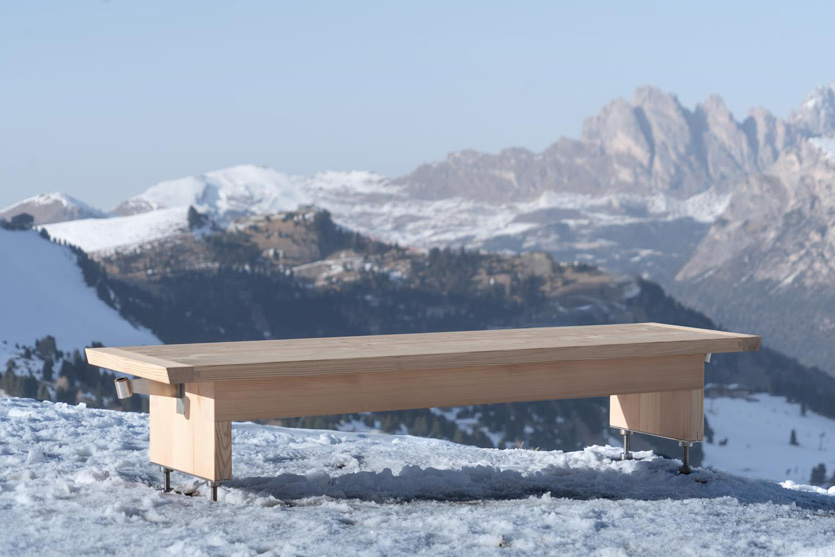
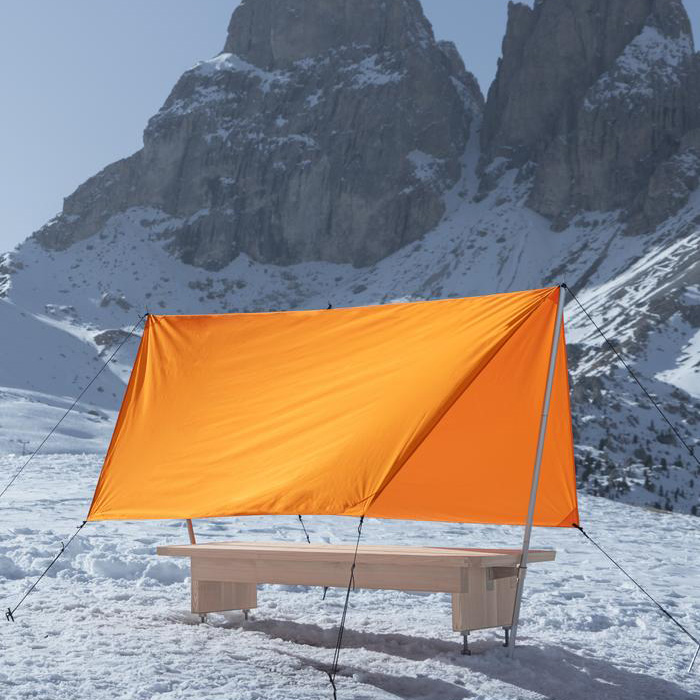
Pancalpina, Studio Francesco Faccin (© Studio Francesco Faccin)
To illustrate his method, Francesco Faccin described one of his latest projects, commissioned by the Trentino regional authorities for a mountain environment. “The starting point was Trentino itself, a largely undeveloped mountain landscape that connected immediately with one of my own passions. I love the mountains and spend a lot of time there. It’s wonderful when we can bring our personal interests into a project: it’s much easier to design something when you have in-depth knowledge of the subject.”
“When this proposal arrived, I began thinking about how the mountains are among the last places in Europe and Italy to remain relatively untouched by human activity. There’s very little infrastructure in the mountains, with vast areas still undeveloped. However, there is some small-scale infrastructure for mountaineers and hikers, such as mountain huts, bivouacs and benches.”
The first thing Faccin did was to go on numerous hikes in the mountains. Projects, he said, “are born from experiencing a place”, not from being shut away in a studio.
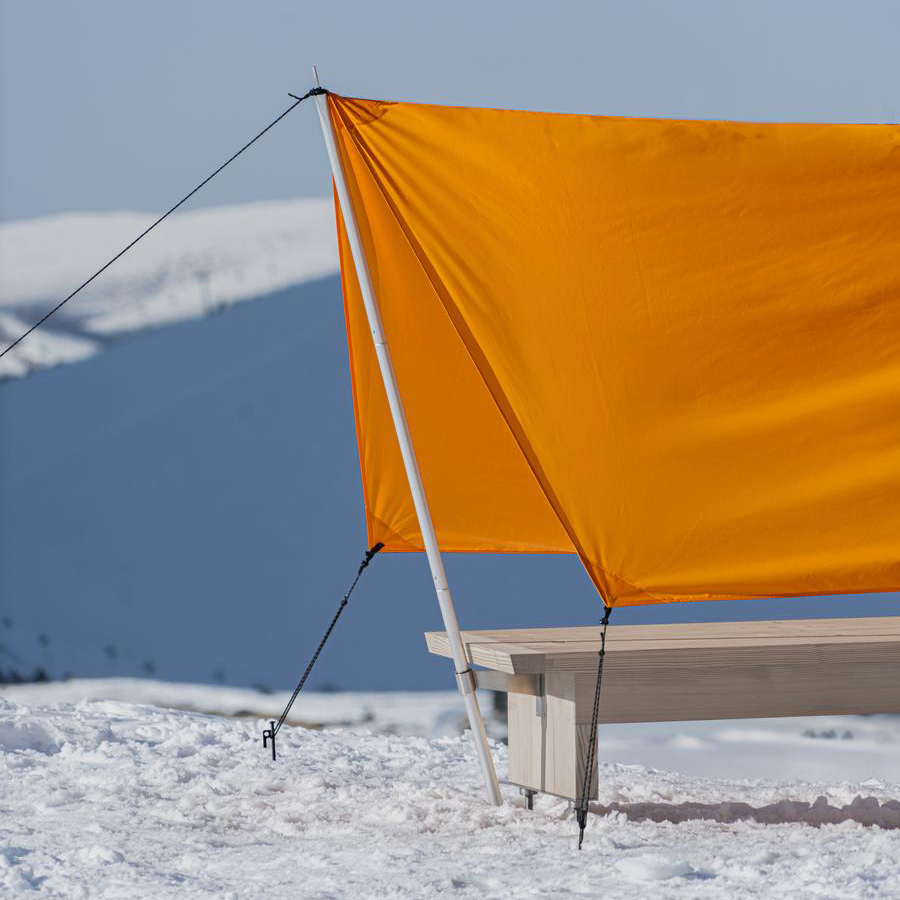
As he hiked the trails and reflected on the growing number of people who visit the mountains without understanding the risks, he came up with the idea of a bench that could serve as an emergency refuge for hikers in difficulty. The project grew out of research, close study of the setting and input from the Italian Alpine Club. The bench thus became an even more basic form of shelter than a bivouac, a point of refuge for anyone who gets into difficulty in the mountains.
Style: yes or no?
Another of the students’ questions concerned style. “I’m very wary of colleagues who have a recognisable style,” he said. “If you visit my website, you’ll find objects that are very different from one another. There’s no recognisable style, and I consider that enormously important. I owe that to my mentor, Enzo Mari. Some designers are instantly recognisable from one project to the next. I distrust that approach because it leads to a kind of mannerism, a form of self-imitation in which the designer continually copies himself. He has found a formula and simply repeats it. Instead, I believe every project must be different. The context, client, material and price positioning all change from one project to the next, so how could the projects possibly look alike? I don’t think we should look for a style; we should look for a method. We need to find a way of analysing the world around us and translating it into a project. That should be a method rather than an aesthetic, otherwise it risks becoming an ego-trip. I don’t want people to recognise my objects and say, ‘Ah, that’s a Faccin object.’ I want them to say, ‘That’s an intelligent project,’ not ‘You can tell Faccin designed it.’ I believe in anonymous design. We are surrounded by objects and have no idea who designed them. I have no interest in an object being a ‘mini-me’.”
Sustainability and the future
Sustainability had come up in several of the students’ questions, but the final one seemed to sum up the central question facing their generation: how should we design for a future in which sustainability will be essential and resources increasingly scarce?
Faccin replied that perhaps the only thing that could save us would be a crisis that forced everything to slow down. “Historically, this is what has always happened,” he said. “The paradox today is that we have reached unprecedented heights in science and technology while at the same time sinking to the lowest point of decline in human history. We have come to understand that growth cannot be unlimited.”
“Are we prepared to imagine a different model of development for society, one that is not based on continual production? I think another model is possible, but it is closely bound up with politics. All these issues we have been touching on so briefly here – including sustainability, which is also discussed in schools – are ultimately political. Your generation,” he continued, “is becoming increasingly disengaged from politics, but I would say the only way to change things is to throw yourselves headlong into politics. To change things, you have to be where the decisions are made. Simply refusing to buy fast fashion will not change things. Of course that’s a political gesture, but it’s not sufficient. Political engagement is essential. That doesn’t mean aspiring to become prime minister; it starts with going out to vote. And this too is about shaping the future: if we don’t like the Italy we are living in, if there are politicians we find unacceptable, the only way to remove them is to vote them out. That way they can be replaced by people who are capable of implementing genuine sustainability policies.”
Watch the video of the Lesson in Reverse led by Francesco Faccin at Cersaie 2026.